
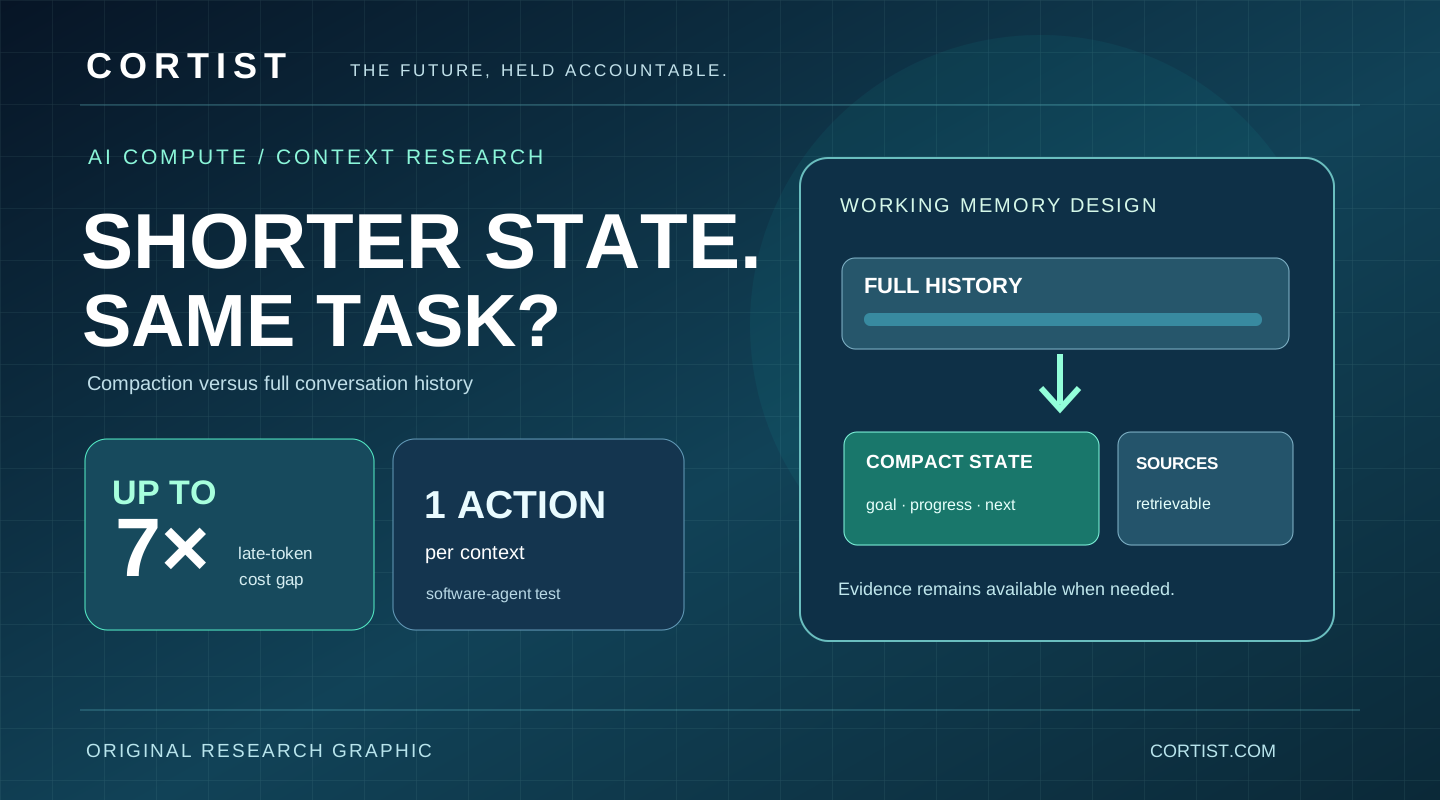
- In an arXiv technical report submitted 3 November 2026, NVIDIA researchers argue that later tokens can cost substantially more to generate than earlier ones; the reported disparity on some open-weight deployments may be as large as 7x.
- The authors report that frequent summarization and state compaction can preserve most measured task accuracy on the long-horizon and long-input benchmarks they tested, even when some software-agent experiments allow one action per model call.
- The report proposes semantic state space models as a research direction. It does not establish that context windows should universally be short, that no data can be lost in summaries or that advertised API invoices will automatically fall by sevenfold.
The Signal
The usual story about AI context windows is straightforward: a model that can read more tokens at once should be better equipped for lengthy software projects, complex documents or multi-hour agent sessions. A new NVIDIA Research technical report, submitted on 3 November 2026, challenges a narrower part of that assumption. The authors ask whether the entire history of a task must remain inside every model call, or whether a compact record of the current task state and access to original source material can carry most of the useful information.
The report, titled “You don’t need long context,” begins with a cost observation. Generating later tokens may require substantially greater serving resources than generating earlier tokens. The authors say the difference on some frontier open-weight models may be as much as sevenfold. This is a reported upper-end comparison under particular serving conditions, not a universal token price multiplier and not an observed reduction in the bill for every customer.
Their experiments then compare keeping a long sequence of previous messages with approaches that periodically compact the conversation. The compacted agent receives a shorter state representation while retaining a way to find older supporting evidence. This distinction matters: compressing the active conversation is not the same as permanently deleting the original files, task instructions or logs.
The Shift
According to the authors, frontier models surrender little or no task accuracy across a range of long-input and long-horizon evaluations when frequent compaction is used. The report also describes software-agent tests in which each invocation takes no more than one environment action before an updated state is handed to the next invocation. Performance reportedly does not collapse, even under that stringent handoff policy.
The proposed mechanism is closer to a carefully managed work log than a brain that can remember everything. A compact state can record the goal, constraints, completed steps, open questions, relevant paths and next actions. The source document or full run history can remain separately accessible when needed. Success depends on whether the compact state carries the right details forward and whether retrieval exposes the relevant original evidence when the model needs to revisit a decision.
That is not a general proof that a short context is always sufficient. A benchmark with programmatic test criteria may tolerate summary loss better than an open-ended research conversation or a legal workflow with unusual exceptions scattered through prior messages. Compaction may itself incur token costs, mistakes or latency. A failure that appears after 40 actions can be harder to diagnose when each step inherits a compressed summary of previous steps.
The economic claim requires equal caution. Serving-time computations for a model with published weights are not the same thing as retail cloud API bills, which incorporate pricing policies, discounts, cache reuse, hardware choices and provider overhead. The 7x figure is a bound reported for certain configurations, not an expected percentage saving or a directly observed total cost ratio across benchmark tasks.
The Cortist Lens
Cortist evaluates AI progress by independently checkable task outcomes and clearly bounded claims. This report is useful because it separates three things that are regularly confused: the maximum amount a model can technically process, the amount that must be present for its next action, and the cost of completing an entire task with an acceptable error rate.
For agent operators, the right experiment is not to assume that the longest possible context is best or that a context summary is always harmless. Run an identical workload under full-history, bounded-history and compaction policies. Preserve access to authoritative source documents, record the rate of successful completed tasks, count retries and human corrections, and calculate total end-to-end cost. A cheaper token call that causes more failures might be more expensive overall.
The timing is relevant to Cortist’s broader coverage of autonomous agents. Our reporting on CLR-Bench examines whether agents learn generalizable rules rather than memorizing examples; BlindToChange investigates whether agents notice new information without a prompt. Context compaction adds another failure surface: does the compressed state retain the evidence needed for correct future decisions? Smaller state is valuable only if the task can continue reliably.
The paper remains a technical report, not an independently certified deployment outcome. NVIDIA is a major supplier of the compute infrastructure involved, making reproducible benchmarks and transparent assumptions especially important. The authors’ semantic state space model proposal should be understood as a prospective architecture idea, not an already proven new model family available for production.
Independent reproduction of compaction gains across different workloads and open-weight models; accuracy after long chains of handoffs; treatment of counterexamples and retrieval failures; total billed cost per completed task; transparency on benchmark harnesses and serving-cost assumptions.
A long-running AI task may not require a long active context at every step. The decisive metric is verified end-to-end success per dollar, not a token-window headline.
Primary sources and evidence limits
This report is an NVIDIA-authored arXiv technical preprint. The sevenfold figure is an upper-bound serving-cost comparison, not a universal API pricing rule. Cortist has not independently replicated the experiments or confirmed the paper’s complete benchmark tables.
The original arXiv work is attributed, not represented as an independent replication by Cortist. Read our editorial standards and research method.
You don’t need long contextPeter Belcak and colleagues at NVIDIA Research; original arXiv technical report, 3 November 2026Original research report — HTML versionFull report by the same authors; source document, not independent replication