
- On October 22, 2026, OpenAI announced general availability of its Decisions API, built with GPT-6 Luna.
- Applications can request a probability, choose among predefined options, or score a situation against a rubric.
- OpenAI advertises up to 10 times faster responses than its Luna Responses API for supported bounded tasks; that is a vendor comparison, not a cross-industry result.
- The company lists $0.10 per million uncached input tokens, with no output-token charges. Pricing and eligibility can change.
The Signal
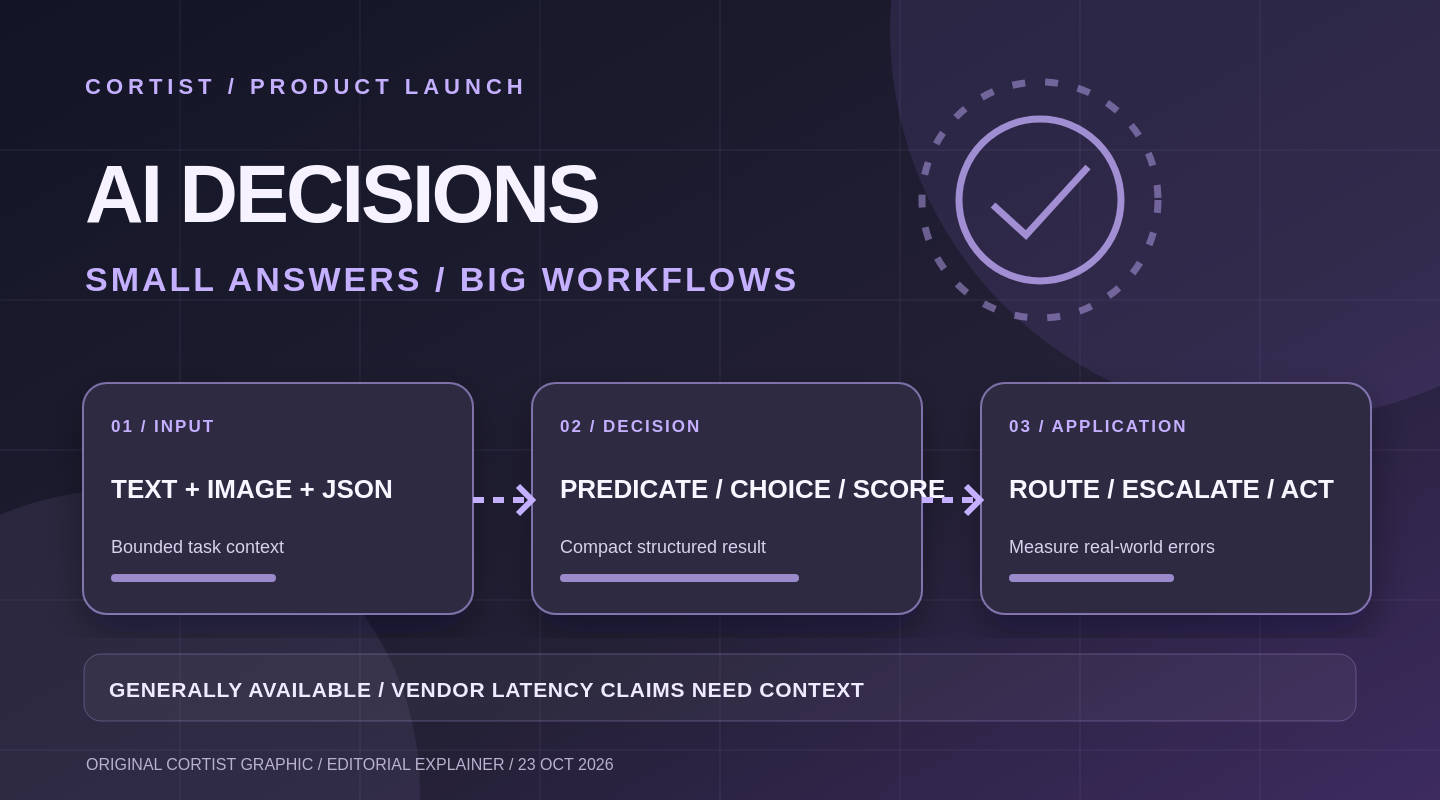
On October 22, 2026, OpenAI announced that its Decisions API is generally available. Instead of generating a long free-form reply, an application submits context and a defined question to receive a compact machine-readable outcome. The product targets repetitive decisions such as request routing, visual classification or agent next-step selection.
The API supports three output styles. A predicate returns a probability for a specified condition; a choice selects from developer-provided options and includes distribution information; a score applies an ordered rubric. Input may include text, structured JSON and images. OpenAI says applications can batch up to 400 questions in one request.
The company says the service uses GPT-6 Luna and is up to ten times faster than using Luna through its general Responses API for supported decision questions. Pricing is advertised at $0.10 per million uncached input tokens, $0.01 per million cached tokens and no separately billed output tokens. These are published product terms, not a guarantee for every workload.
The Shift
This launch matters because real AI applications frequently make thousands of small operational choices. An assistant might decide whether to search, ask a follow-up question or escalate a task. Paying the latency of a long generative call for each simple routing step can make a whole workflow feel slow.
OpenAI has also added integration with GPT-Live, prompt caching and processing-residency options in the United States and European Union. That makes the new endpoint relevant to real-time voice interfaces, where a late response may matter more to the user than another paragraph of generated reasoning.
Company-cited customer examples range from document classification to operational cost attribution. Box reported roughly five-times faster routing on a 30-case evaluation with comparable accuracy; Sierra reported under 280 milliseconds at its 95th-percentile latency. These customer case studies are specific reported tests. They should not be read as independent evidence that every implementation will be faster, cheaper or equally accurate.
The Cortist Lens
The most useful distinction is between a fast answer and a correct decision. A low-latency service can improve responsiveness while still misclassifying ambiguous inputs or confidently choosing the wrong action. For higher-impact tasks, teams should test accuracy, calibration, abstention paths and human review on their own data.
This is a product-infrastructure development rather than proof that a new general intelligence threshold has been crossed. The Decisions API does not establish AGI, and OpenAI's reported speed gains are not independent safety or reasoning benchmarks.
Developers should compare end-to-end task completion times, total cost including retries and data movement, error rates and failure modes. A specialized decision endpoint can be powerful when a question has clear allowed outputs; it should not be substituted for open-ended research or treated as a universal problem solver.
For a normal product launch, the actionable next step is developer-side testing: compare classification quality, median and tail latency, costs including failed calls, and handling of uncertain inputs. This article is archived as a release report; it has no dedicated ongoing evidence-watch task.
A meaningful practical infrastructure launch for fast AI-agent orchestration. Attractive advertised pricing and latency, but individual deployments must validate their own quality and failure rates.
Primary sources & editorial note
This source-linked standard news item was published on October 23, 2026. Claims concerning benchmarks, pricing, feature support and performance remain attributed to their developers or named customers unless otherwise noted. Editorial context is Cortist analysis. Archive class: Standard News. This report is not enrolled in a dedicated continuous Evidence Watch or monitored forecast register.
OpenAI product announcementPrimary source · October 22, 2026OpenAI API product news listingRelease-date confirmationOpenAI developer platformOfficial documentation and product access