
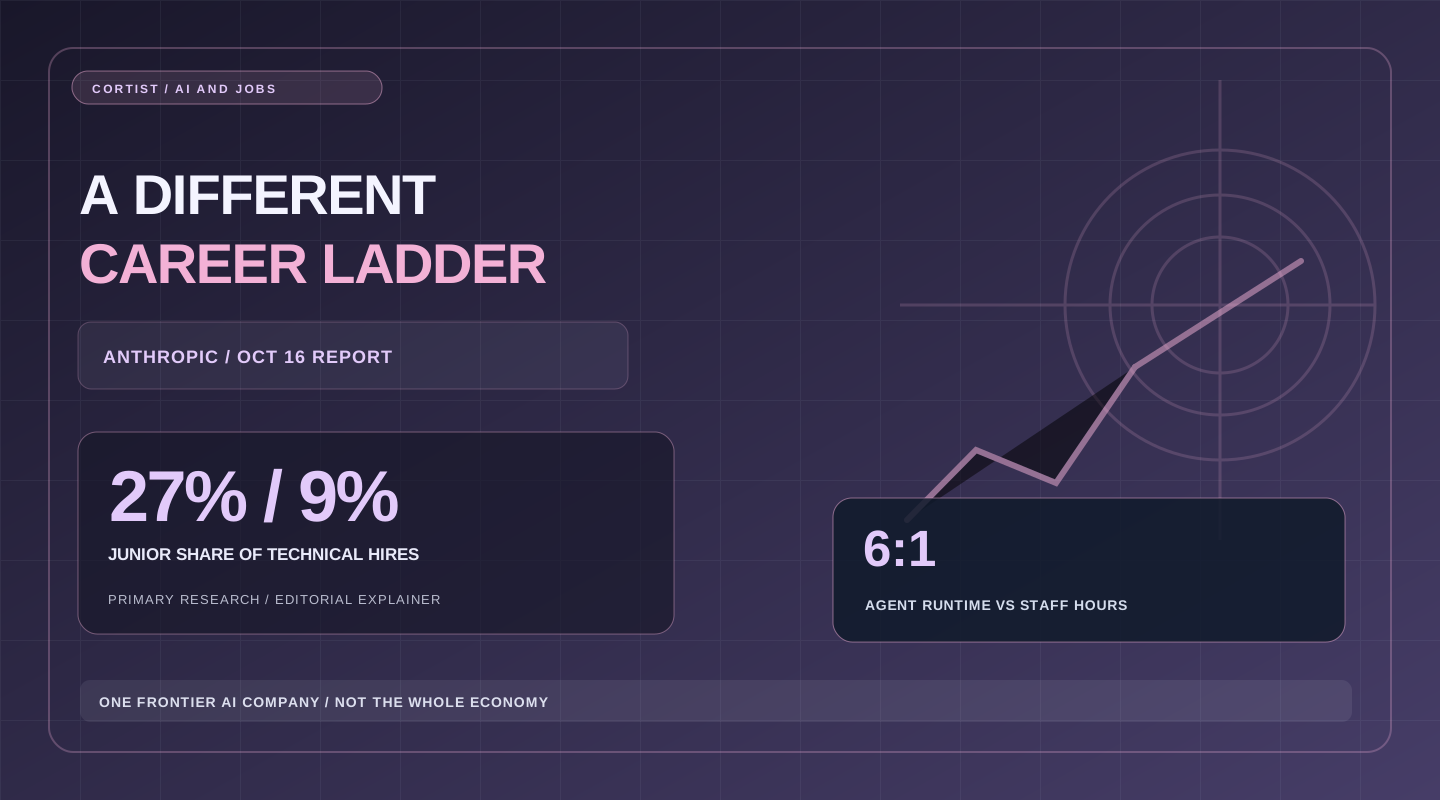
- Anthropic reports junior-level employees' share of technical departments falling from 21% to 14% since early 2025.
- The proportion of junior technical hires declined from 27% to 9% over the period described in its October 16 workforce study.
- By August 2026, employee-directed interactive AI-agent runtime amounted to six times assumed human employee work hours under Anthropic's defined counting method.
- These are company-specific composition and runtime metrics, not a causal estimate of economy-wide job displacement.
The Signal
An AI company's internal employment data now offer a rare look at what changes when advanced agents become part of ordinary work. In an October 16 research report, Anthropic says the share of junior-level employees in its technical departments dropped from 21% to 14% since early 2025. More strikingly, the share of junior hires among technical recruits fell from 27% to 9%.
That is a change in the composition of employees and hires, not necessarily a drop in the absolute number of junior employees at every point. Anthropic is expanding rapidly, so proportional declines can coexist with growth in overall headcount. The company also says technical roles are becoming a smaller share of its expanding workforce as business functions such as sales, recruiting and finance grow.
The report brings together internal staffing, tool-use telemetry, output indicators, surveys, interviews and hiring records. It offers unusually granular evidence from a setting with widespread AI adoption, although it was conducted by the company whose products and decisions are under examination.
The Shift
Anthropic describes April 2026 hiring discussions in which engineering and research teams gave less emphasis to lower-band technical roles. Roughly one-third of surveyed machine-learning managers and one-fifth of software-engineering managers said they were hiring less because of AI. These are responses from managers, not experimentally measured causal effects across the technology industry.
Within the lab, AI systems also perform large amounts of work as autonomous or employee-directed agents. By August, Anthropic reports six hours of employee-directed interactive agent runtime for each hour of assumed human employee work time. The figure counts computer-agent execution and tool use, not six employees' worth of productive economic output. Several agents can run concurrently, tasks differ enormously in difficulty, and unsuccessful computation also uses runtime.
The company reports higher code output per engineer and activity gains in some nontechnical functions as agents spread. Yet the research admits important limits: employees choose when to adopt agents, revenue and company growth are changing at the same time, and more lines of code or more transactions do not automatically mean better outcomes. Human attention is becoming the scarce resource as staff review, coordinate and correct large volumes of automated output.
The Cortist Lens
The central issue may be the apprenticeship pipeline. Early-career engineers historically gained experience by implementing small features, fixing routine bugs and learning by observing senior reviewers. If agents assume a larger share of that work, companies will need new ways for junior employees to acquire the judgment required for future leadership and safety-critical decisions.
Anthropic highlights growing demand for autonomy, contextual judgment and agent oversight. It also describes internal redeployment as work changes. Those choices show that organizational policy influences who benefits from automation; future employment outcomes do not flow mechanically from model capability alone. A lab producing its own powerful AI is especially unlikely to represent every hospital, manufacturer, public agency or small business.
The next evidence needs comparison groups across independent employers, changes in absolute junior headcount, pay and internal career progression, plus assessments of code quality and safety. The question Cortist would like to track is not whether a model can generate a patch, but whether firms keep creating paths for people to become experienced professionals. Our AI & Jobs hub treats that as a research question, not a probability forecast.
Look for independently replicated changes in junior hiring outside frontier AI labs, absolute headcount rather than shares alone, and evidence that firms are building credible apprenticeship paths around AI agents. This is an archived standard news report without a dedicated automatic Evidence Watch.
Anthropic's own numbers make the changing technical career ladder concrete. A 27%-to-9% drop in junior hires' share is significant inside that company, but it is not a measured 18% unemployment increase, nor proof that every employer is replacing juniors with agents.
Questions readers ask
Direct answers based on what the evidence currently shows. A measured association is not a guaranteed forecast.
Did Anthropic cut junior hiring by 18 percent?
Not on the published evidence. The share of junior technical hires fell from 27% to 9%, a decline of 18 percentage points. That is not an 18% decline in total junior jobs or a general industry unemployment rate.
Does the six-to-one agent number mean agents replaced six workers?
No. It compares defined agent runtime with human hours estimated using employee headcount and a 40-hour week. Agent runtimes are not interchangeable with human labor productivity or headcount.
Why could AI hurt entry-level careers before senior roles?
Routine implementation can be delegated to tools while human oversight and complex decisions remain important. That hypothesis needs verification in independent employment and hiring data.
Does Anthropic's report apply to the whole economy?
No. Anthropic is an unusually AI-intensive and fast-growing technology company; its internal patterns cannot automatically be generalized across sectors.
Primary sources & editorial note
Source limitation: A company's junior hiring share is not a causal estimate of AI's effect on an entire labor market. Read our editorial standards for attribution and corrections.
Anthropic, How employment is changing at Anthropic, October 16 2026Primary full internal employment and agent-use analysisAnthropic, Working at the frontier shapes expectations, October 16 2026Companion research on frontier employees and public expectationsILO, empirical jobs and productivity evidence review, June 2026External comparative context