
- Anthropic and commercial collaborator Diode Computers reported three built and functioning prototypes: a USB-C speakerphone, a voice-assistant hub and a handheld virtual pet. Claude Fable 5.2 generated schematics, PCB layouts, firmware and enclosure designs; Diode engineers performed the physical manufacturing and tests.
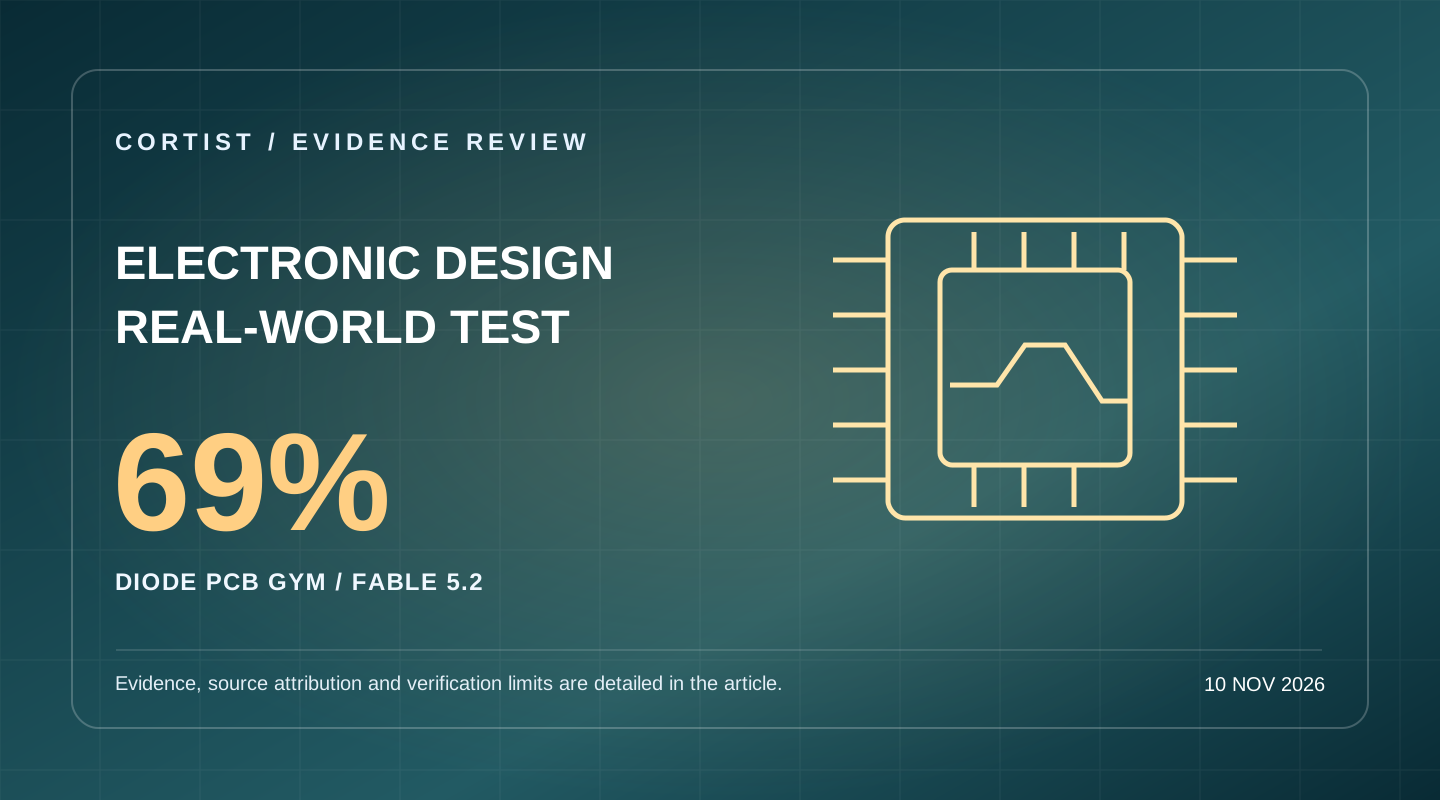
- On Diode's internal PCB Gym, Anthropic reports Fable 5.2 scored 69% compared with 25% for Fable 5. The newer model also scored 83.5% on public BenchCAD 2.1, according to the provider. Neither benchmark directly measures field failure rates for manufactured products.
- Anthropic explicitly says the three early prototypes have not completed electrical validation, antenna tuning, thermal testing or commercial certification. The boards were not designed for mass production; the collaboration with Diode has a commercial relationship.
The Signal
Hardware design is a useful reality check for claims about capable AI agents. A model can draft plausible schematics and produce attractive CAD views while still choosing incompatible components, laying traces incorrectly or overlooking how a device is assembled. The real test is whether those files produce a functioning physical object.
On 9 November 2026, Anthropic reported that Claude Fable 5.2 designed three devices from short starting prompts in collaboration with Diode Computers: a speakerphone, a voice-assistant hub and a handheld virtual pet. It created schematics, routed printed circuit boards, selected parts, designed enclosures and wrote firmware. Engineers at Diode built the devices from the generated files, and Anthropic reports the prototypes worked without circuitry adjustments after manufacturing.
The quantitative evidence includes a 69% score on Diode's internal PCB Gym component-placement and routing benchmark versus 25% for Fable 5, plus a reported 83.5% on public BenchCAD 2.1. These are meaningful task signals, but scores from internal tasks and finished prototype demonstrations are not the same as a blinded comparison against experienced engineering teams.
What the evidence changes
The report's engineering details are more revealing than a generic claim that Claude 'builds hardware.' It describes the model rerouting crowded copper traces, reassigning pin connections on a speakerphone to avoid interfering with touch controls, and redesigning a microphone opening because the original acoustic resonance was poorly placed for speech. For one voice hub, it wrote its own grid-based routing code to handle long connections more efficiently.
The agent also ran design-for-manufacture checks and interpreted them instead of obeying every warning blindly. On one board, it corrected six overly thin solder-mask slivers. It correctly treated an intentionally shared ground connection as acceptable even though an automated checker flagged it. These examples suggest it could combine formal tooling, parts documentation and design constraints over a multi-stage project.
The limitations are explicit. Diode still fabricated and physically tested all devices. The systems have not passed systematic electrical validation, antenna tuning, heat tests or regulatory certification, and they were not optimized for mass production. The fact that a speakerphone remains usable after weeks is encouraging, but no independent failure-rate, bill-of-materials cost or engineering-hours reduction study is presented.
The Cortist perspective
Cortist considers a functioning physical prototype stronger evidence than a generated image or benchmark score alone. Still, a three-device demonstration has serious selection limits. It does not tell us how often the same agent fails on an unseen board, how much human checking was required, whether design files contain latent defects or how repair costs compare with a conventional workflow.
The source also discloses a commercial relationship between Anthropic and Diode. That should be transparent in reporting, without automatically negating the specific observed prototypes. Independently validated design outputs would require sourceable design files, hardware revisions, detailed test logs and outside testing under controlled requirements.
The adjacent scientific question is whether agents can reliably combine digital work with physical feedback. Anthropic says future work will target denser and faster designs and learning from actual measurements. Until that happens, this result is about producing plausible and apparently functional prototypes—not certifying safe, high-volume electronics manufacturing.
- Publicly inspectable PCB, firmware and CAD files with revision history, production costs and traceable real-world test results.
- Independent blinded benchmarks comparing failure rates, human correction hours, component sourcing and repeatability on unseen designs.
- Electrical, thermal, electromagnetic interference, antenna and certification reports for the three prototypes or representative successors.
- Measured results on denser, faster and more safety-critical electronics, where a design that works once may still be insufficient.
Three working prototypes make this a meaningful engineering-agent demonstration. The open question is not whether AI can draft boards, but whether it can consistently deliver verified and economically competitive hardware beyond a small curated set.
Primary sources and verification boundaries
The original publications report a developer-run formal-verification study, an operational control design and a small engineering prototype campaign. They are different evidence types. Cortist has not independently reproduced private tests or certified a hardware product.
Read our editorial standards and research methodology.
Anthropic: Testing Claude on real-world electronics designOriginal report and benchmark details, 9 November 2026Cortist: AI agents and the reality of physical engineeringRelated research framework, not an independent reproduction