
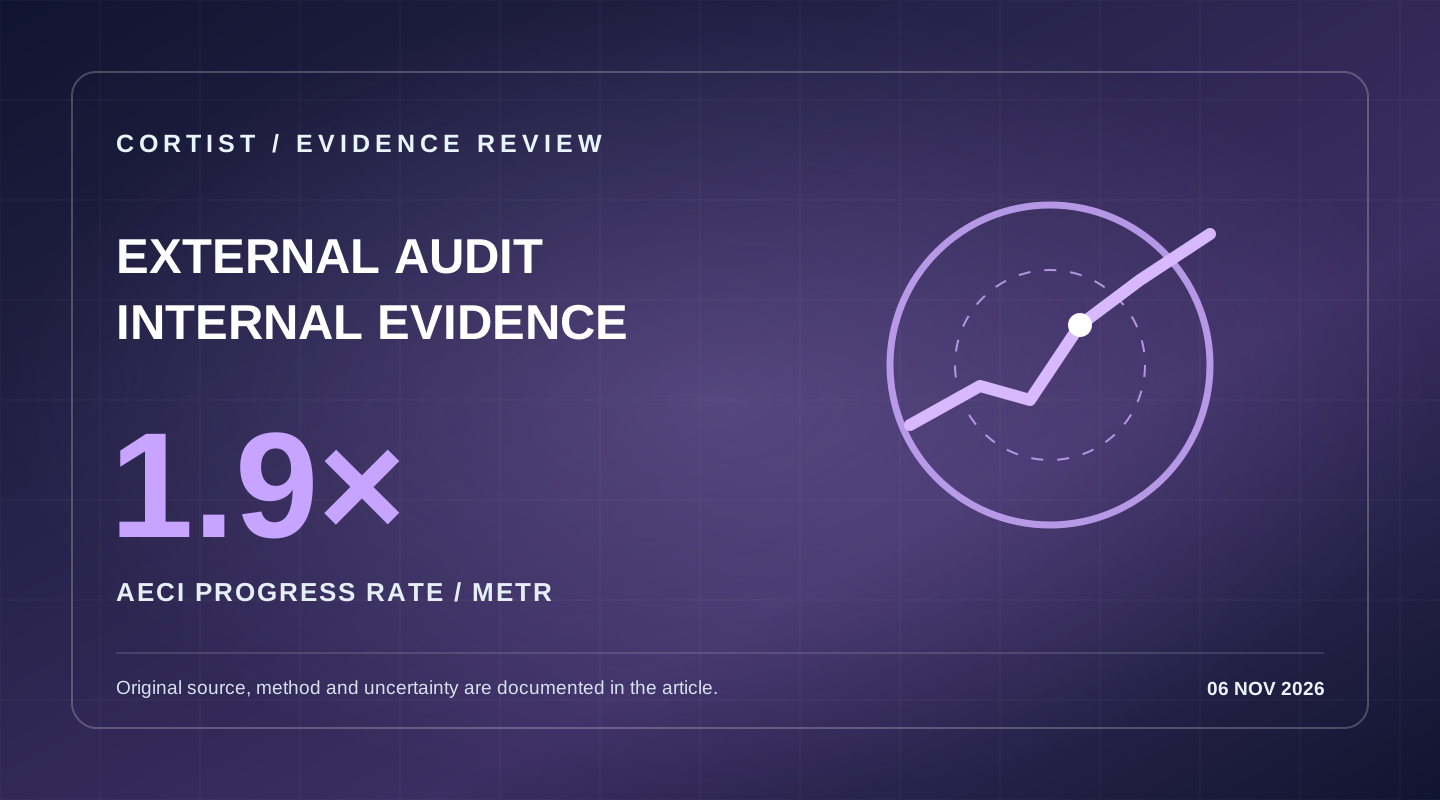
- METR's independent eleven-week assessment at Anthropic, conducted August 12–October 29, 2026, estimates 1.9 times the previous rate of growth on Anthropic's AECI well-specified-task benchmark, with a 95% confidence interval of 1.5–2.8 times.
- METR judges AI assistance likely responsible for a majority of the recent acceleration and says rising training-compute growth was not the explanation. It stresses attribution uncertainty and reports that fully autonomous, highly significant model-training contributions are not yet established.
- Anthropic exercised contractual redaction rights over much of the evidence METR found most important. The public can read independent conclusions, but cannot reproduce every underlying inference from disclosed data.
The Signal
An external evaluation of how AI accelerates AI development is unusually important because the subject is often measured by the same companies building frontier models. On November 5, 2026, METR published its independent assessment after spending roughly eleven weeks, from August 12 to October 29, with high access to Anthropic's internal research process. The work examined benchmark trajectories, training inputs, qualitative interviews and evidence of AI use in model development.
METR's key public estimate is a 1.9-fold acceleration in the rate of growth of Anthropic's internal AECI benchmark since October 2025 compared with the preceding period, with a reported 95% confidence interval of 1.5–2.8. A twofold acceleration in this sense means compressing roughly two years of former benchmark progress into one year. It does not mean that every individual model is twice as capable, that every task is completed in half the time, or that a doubling will persist indefinitely.
The assessors concluded that the observed change was not caused by a faster growth rate in training compute. They judged that AI assistance was likely responsible for most of the recent acceleration. But they explicitly did not establish a clean causal decomposition: hiring, workflow changes, algorithmic discoveries, data quality and the chosen benchmark could all matter. METR also recognized that some earlier acceleration may have non-AI explanations.
What the evidence changes
The assessment included confidential model scores and interviews, and some of the strongest evidence was not made public. METR says Anthropic had rights to redact non-public material, and did redact a majority of the evidence the assessors found most informative. The authors still disclosed high-level conclusions and described the kinds of evidence unavailable for public scrutiny. That makes this independently conducted work materially different from a fully open, independently reproducible data release.
METR reports robustness analyses that vary the estimate substantially under different choices, and its authors state that plausible interpretations range well beyond a single point estimate. AECI measures well-specified tasks and may be unusually sensitive to model improvements that do not translate directly to open-ended scientific judgment, product reliability or societal impact. Unreleased internal models and varying task mixes complicate comparison with publicly accessible models.
A more subtle distinction concerns people using AI to build AI. Staff interviews and informal polls support claims of substantial assistance, while METR calls an approximately twelvefold employee self-reported speedup weak evidence: quick reactions are not controlled productivity experiments. The researchers say AI is not yet making highly significant, fully autonomous contributions to the most important parts of training, even though they see signs of more autonomous research work developing.
The Cortist perspective
Cortist sees a meaningful warning signal here, not confirmation of an autonomous self-improvement runaway. The strongest narrow conclusion is that an independent team with unusual private access believes Anthropic's progress on certain tests accelerated sharply. Whether this predicts broader autonomous R&D, general scientific breakthroughs or a future loss-of-control risk remains an open empirical question.
Access and independence need separate labels. METR was external to Anthropic, had unusually detailed visibility and publicly disclosed limits on what it could show. Anthropic's redaction rights reduced the public's ability to audit pivotal evidence. One should neither dismiss the assessment simply because evidence was redacted nor promote its interpretation to an independently reproduced benchmark series that outsiders can rerun today.
METR also reports that an originally planned compute-allocation verification component was canceled during the engagement before reaching substantive conclusions. This matters for accountability because a detailed study of capability acceleration is not also proof that an organization's actual compute resources are allocated as described between safety and capability efforts. Each claim requires its own measurement and verification record.
- Repeat the AECI trend on fixed, documented task families and provide credible summaries of the currently redacted key inputs without revealing sensitive capabilities.
- Distinguish human-plus-AI assistance from autonomous model-training contributions with preregistered criteria and reproducible task-level accounting.
- Track whether independent access agreements preserve the ability to disclose materially important contrary evidence and limitations.
- Look for evidence that faster benchmark progress translates to external, less well-specified scientific or operational tasks without hidden benchmark overfitting.
Independent scrutiny can meaningfully constrain industry narratives even when some evidence remains private. METR's 1.9x finding is important, but its uncertainty, redactions and task scope are essential parts of the result—not footnotes to be dropped when reporting acceleration.
Sources, provenance and limits
The figures above are attributed to primary reports and specified assessments. Company-run benchmark results, an external assessment with redactions and usage classifications do not provide the same kind of evidence. Cortist has not independently rerun the tests or inspected private source datasets.
Each source link identifies the party responsible for the original statement. Read the editorial standards and research methodology.
METR: Independent Assessment of AI R&D Acceleration at AnthropicIndependent primary report, 5 November 2026METR: Review of the automated-R&D risks section of Anthropic's August reportCompanion independent risk-report review, 5 November 2026Cortist AI Existential Risk researchCortist contextual research hub, not a second independent replication