
Can two AI safety scores be compared directly across products?
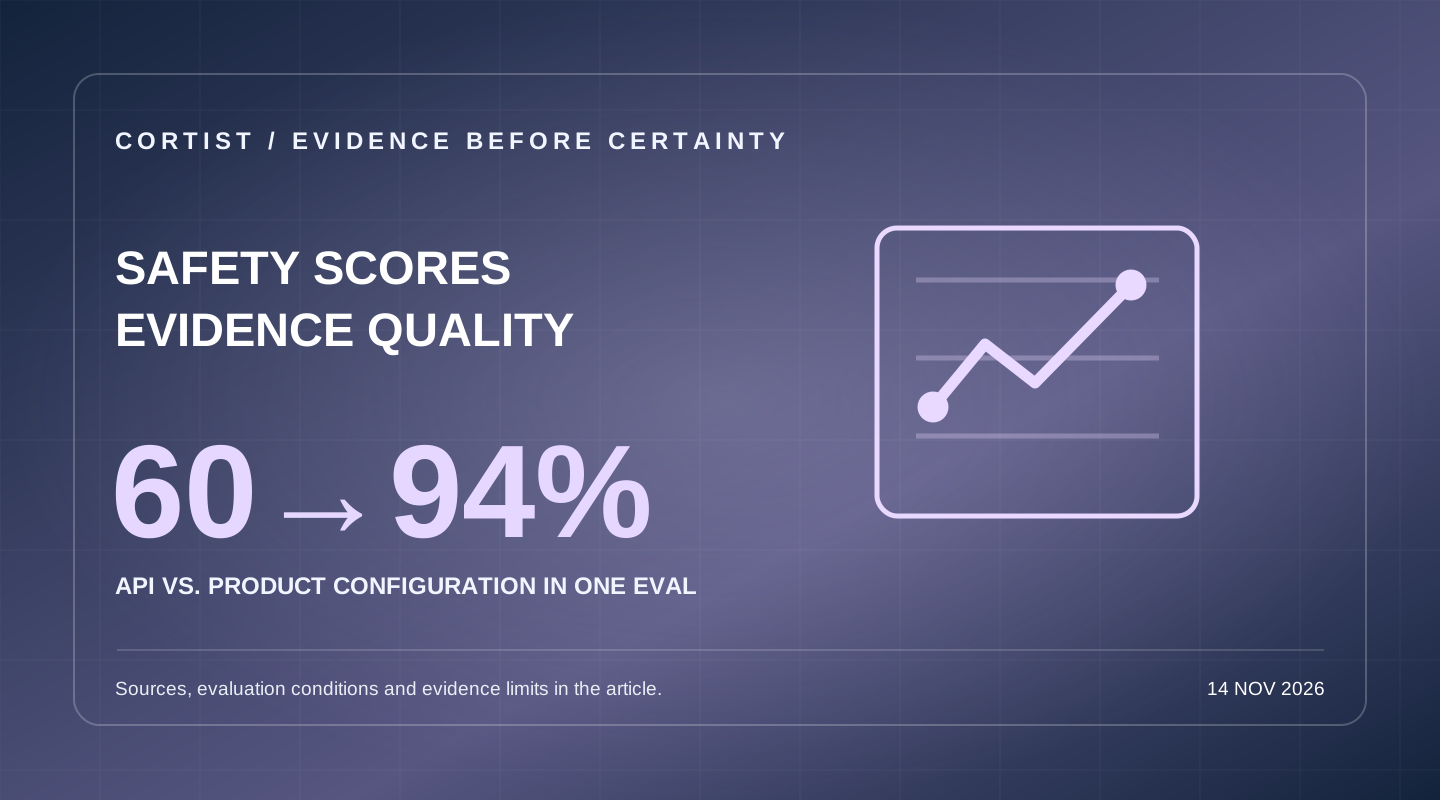
Not without matching the task, prompts, system instructions, tools, graders and statistical uncertainty. Anthropic reports a 60% appropriate-response rate via one API setup and 94% on claude.ai after targeted system-prompt mitigations in a self-harm-related evaluation. The comparison includes a changed product configuration and does not isolate a change to the underlying model.
- Anthropic's November 13, 2026 engineering guide recommends specifying the safety construct, validating graders against human experts, preregistering analysis plans, running repeated tests and reporting uncertainty and failure cases.
- One disclosed self-harm-related evaluation improved from 60% appropriate responses on the API to 94% on claude.ai with updated product system prompts. These are unlike configurations, so the 34-point difference is not a controlled model-to-model gain.
- Anthropic says its recent single-turn API safety suites often score 94–98%, making them useful mainly as regression checks. It treats about 100 scenarios as a floor for complex multi-turn tests and 1,000 for simpler single-turn tests.
The Signal
Safety benchmarks affect model releases, safeguards and public claims of improvement. Yet numbers presented in isolation can conceal the most important question: exactly which system was evaluated, under what conditions and against which notion of harm? A score can change when the evaluator changes, the prompt changes or the product wraps the model in new instructions.
On November 13, Anthropic published an engineering guide to stronger AI safety evaluations. The authors compare evaluation design to scientific measurement: define the behavior of interest, create realistic scenarios, calibrate human and machine graders, preregister the analysis and report statistical uncertainty instead of reducing complex risks to one success percentage.
The article includes a striking product-surface example. During review of self-harm evaluations, Anthropic found that a Claude model sometimes implicitly validated self-harm as a coping strategy even when it discouraged it. The company revised the system prompt and says the appropriate-response rate in that evaluation reached 94% on claude.ai, compared with 60% on its API setup. Different wrappers make those numbers incomparable as an isolated measure of the model weights.
What the evidence changes
The guide warns that easy tests can saturate. Anthropic reports aggregate harmless-response rates between 94% and 98% for its recent single-turn API suites, leaving little signal to distinguish models that fail in longer or more realistic interactions. Multi-turn tests, subtle escalations and domain-specific scenarios can expose risks that single prompts miss, but demand larger samples and careful evaluation.
Anthropic recommends expert checks of automatic graders. If the grader misses harmful subtleties, a headline percentage can look more favorable than the underlying transcript quality. Researchers should also cover different languages, modalities, product surfaces and tool settings, and vary factors independently enough to distinguish severity from the requester's tone or other confounds.
Uncertainty matters. The authors say confidence intervals on some multi-turn results can exceed plus or minus ten percentage points. A small score difference may therefore be sampling noise. Their suggested minimums of roughly 100 examples for complex multi-turn evaluations and 1,000 for simpler single-turn evaluations are practical floors, not universal mathematical guarantees of validity.
The Cortist perspective
Cortist considers the evaluation design part of the evidence. A reported 94% response rate is not proof of 94% real-world safety if the scenarios, deployment context or grader miss the relevant failure. Conversely, an improvement caused by a system prompt can matter greatly to product users, but should be attributed to the deployed system rather than described as a change in raw model alignment.
Independent audits should verify scenario selection, human grader agreement, variability across runs and whether an evaluation was preregistered. Useful reporting also identifies what went wrong in unsafe examples and whether the resulting mitigations hold in real user sessions. A company-authored methodology recommendation is useful but not itself an external certification.
This analysis extends Cortist's WipeBench coverage, where an agent could avoid dangerous side effects yet fail to complete legitimate tasks. It also connects to monitoring and shutdown claims: evaluations must test the deployed workflow, including tool permissions, interruptions and delayed effects, not merely model text in a controlled prompt.
- Published per-category distributions, uncertainty intervals, repeated runs and matched product configurations rather than only aggregate safety scores.
- Grader agreement against blinded human experts, including tests for false reassurance and missed harmful nuance.
- External replications using genuinely unseen multi-turn scenarios and relevant languages and product surfaces.
- Whether targeted mitigations remain effective over time and in realistic cases, with documented regressions.
A safety score is only as strong as its question, measurement process and deployment context. Anthropic's examples show why auditors must separate model behavior from product safeguards and report uncertainty before declaring a system safer.
Frequently asked questions
Did Anthropic improve an underlying model's safety by 34 percentage points?
The reported rates were 60% via an API evaluation setup and 94% on claude.ai with new system-prompt mitigations. Since the product configurations differ, this is not an isolated 34-point change in model weights.
Why are high single-turn safety scores insufficient?
Easy single-turn sets can saturate at 94–98% while longer conversations and realistic workflows expose different failure modes. Scores also depend on graders, user behavior, tools and context.
What makes a trustworthy safety evaluation?
Clearly defined risks, realistic scenarios, human-validated graders, preregistered methods, repeated tests and statistics that disclose uncertainty and relevant failures.
Original sources and verification limits
Cortist separates operator disclosures, company-authored evaluation guidance, and preliminary research benchmarks. We have not independently replicated proprietary incidents or externally validated the benchmark score. Attribution is not an independent verification certificate.
Anthropic: Building strong safety evaluationsOriginal engineering guide, published November 13, 2026Cortist: WipeBench coding-agent safety and completionRelated Cortist analysis, not independent replication of Anthropic's exampleSee our methodology, editorial standards and the Evidence Graph.