
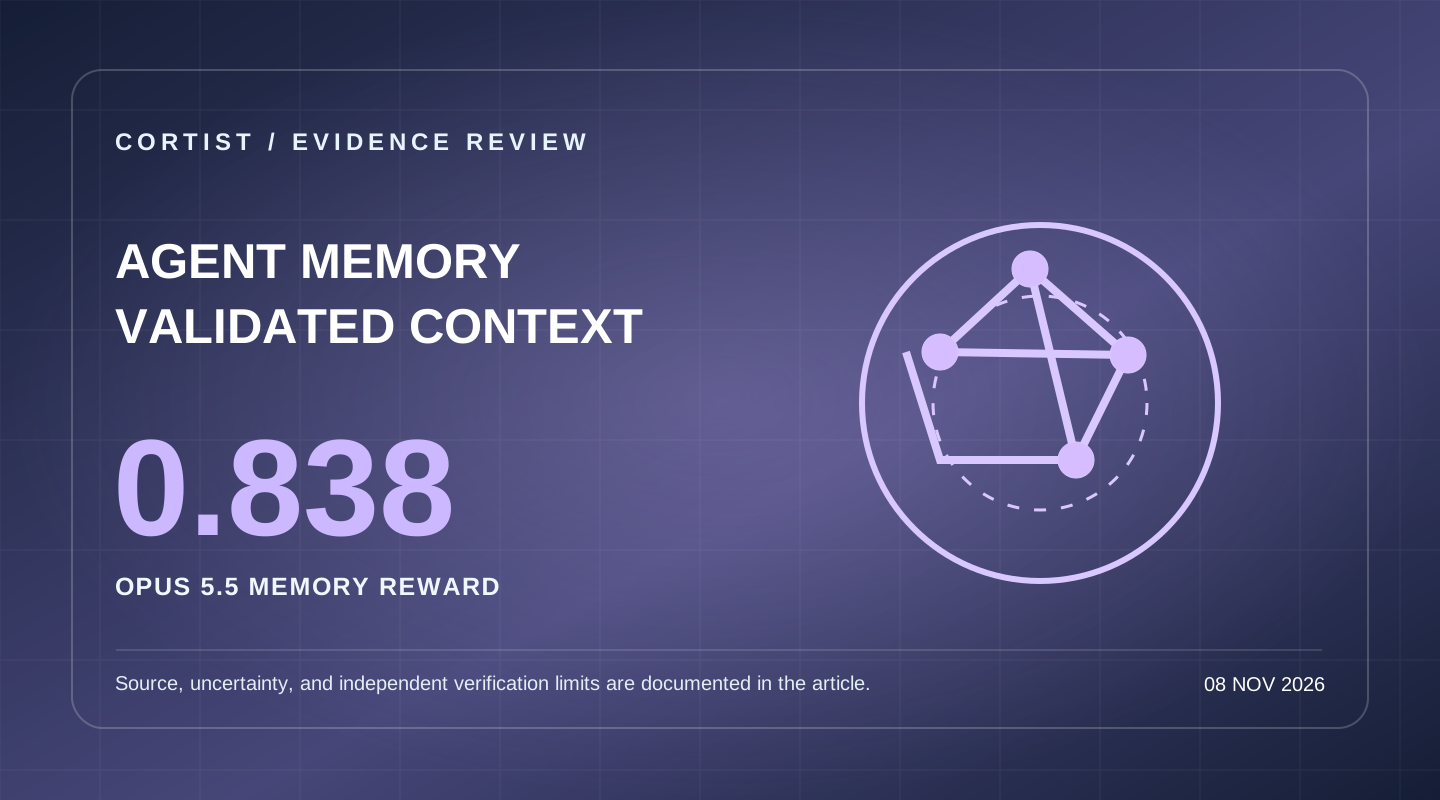
- Anthropic's 6 November engineering report compares stateless and persistent-memory agents on a CL-Bench database task. Claude Opus 5.5 rises from 0.655 mean reward without memory to 0.838 with memory; Sonnet 5.5 rises from 0.644 to 0.833 under the reported setup.
- A gaming example contrasts Sonnet 3.7's 413 files across 225 folders, resulting in one badge, with Fable 5's nine files plus one global note and four badges at a similar point. This is a qualitative cross-model illustration, not a controlled same-model causal comparison.
- In a 25-question evaluation over approximately 350,000 enterprise files, Anthropic reports search-plus-wiki performance improving from 54% to 61% as its memory representation grew; search alone scored 53%. Some wiki workflows produced bloated representations and even overwritten facts.
The Signal
AI agents often repeat avoidable mistakes across sessions because yesterday's verified result or corrected assumption is not available when a new task starts. Simply storing every transcript is not a solution: long logs contain noise, stale states and contradictory notes. Agents must choose what to remember before they know which detail the next session will need.
Anthropic's 6 November engineering report describes a hierarchy: immediate event logs, curated memory notes, linked representations such as wikis, and a small context layer injected at session start. The company calls offline reorganization and correction 'dreaming'. This is a model-assisted maintenance process, not a claim that the system has human sleep, consciousness or episodic memory.
The report gives a concrete benchmark signal. On one CL-Bench database task, Opus 5.5's mean reward improves from 0.655 without persistent memory to 0.838 with it; Sonnet 5.5 improves from 0.644 to 0.833. These results show gains within a particular harness and repeated-question task. They do not establish that memory will always improve performance across changing organizations, data access rules and long-lived agents.
What the evidence changes
The most useful finding is not that more memory wins. In a Pokémon Red evaluation, an older Claude model accumulated hundreds of files, many restating information visible on screen. A newer model kept a small set of durable strategies and progressed further. But different models were compared, so the memory layout should not be credited with the entire performance difference.
A second result tests linked wikis against direct retrieval. Anthropic reports an internal corpus of about 350,000 files and 420 million tokens. On 25 questions, search combined with the evolving wiki moved from 54% to 61% of graded criteria while search alone scored 53%. On some legal-document tasks the wiki improved cross-document reasoning; on more directly searchable tasks it provided little benefit. One generated wiki even became larger than the source corpus.
Memory can also propagate errors. Anthropic shows an agent recording a wrong location in a game and then repeating a bad navigation decision. An offline pass revisited the transcript and corrected the note. In a separate legal-document case, simultaneous edits to a shared memory page lost contractual facts; restructuring notes by source prevented the overwrites. These examples expose two distinct reliability issues: incorrect facts and unsafe concurrent modification.
The Cortist perspective
For Cortist the key distinction is between storage, retrieval quality and trustworthy retained knowledge. A memory file is only a record of something an agent wrote. To become an accountable fact it needs original provenance, a checkable update history, clear scope and a rule for invalidation when the world changes.
These internal tests do not resolve privacy or security questions. A long-running enterprise agent might retain confidential information, outdated permissions or malicious instructions. Evaluation should cover source attribution, unwanted retention, cross-user isolation, deletion, contamination and agent behavior when a retrieved memory conflicts with current evidence.
Better memory could become a meaningful component of long-horizon autonomy, but the evidence here is task- and product-specific. Benchmark gain is not proof of safe operation without supervision. An independent evaluation would track both successful task completion and the cost of stale or harmful memory across weeks of real workflows.
- Independent memory ablations that hold model, prompts, task distribution and total compute constant.
- Longitudinal measures of stale-fact propagation, conflicting updates, source attribution and reliable deletion.
- Tests of context injection and memory-retrieval attacks in multi-user settings.
- Evidence of sustained task improvement when goals and source documents change, not only when previous answers reappear.
The strongest agent memory is not the largest transcript archive. Anthropic's tests support selective, revisable memories, while also showing why unverified notes and concurrent edits can undermine reliability. Real-world retention and correctness remain to be audited.
Primary sources and verification boundaries
The original publications describe developer-run benchmarks, engineering observations and workflow demonstrations. Cortist has not replicated private test datasets, reproduced proprietary experiments or validated downstream laboratory outcomes. Source attribution does not imply endorsement.
Read our editorial standards and research methodology.
Anthropic: The components of agent memoryOriginal engineering and evaluation report, 6 November 2026Continual Learning Bench (CL-Bench) 1.0Benchmark project cited in Anthropic's evaluation; study results remain provider-run