
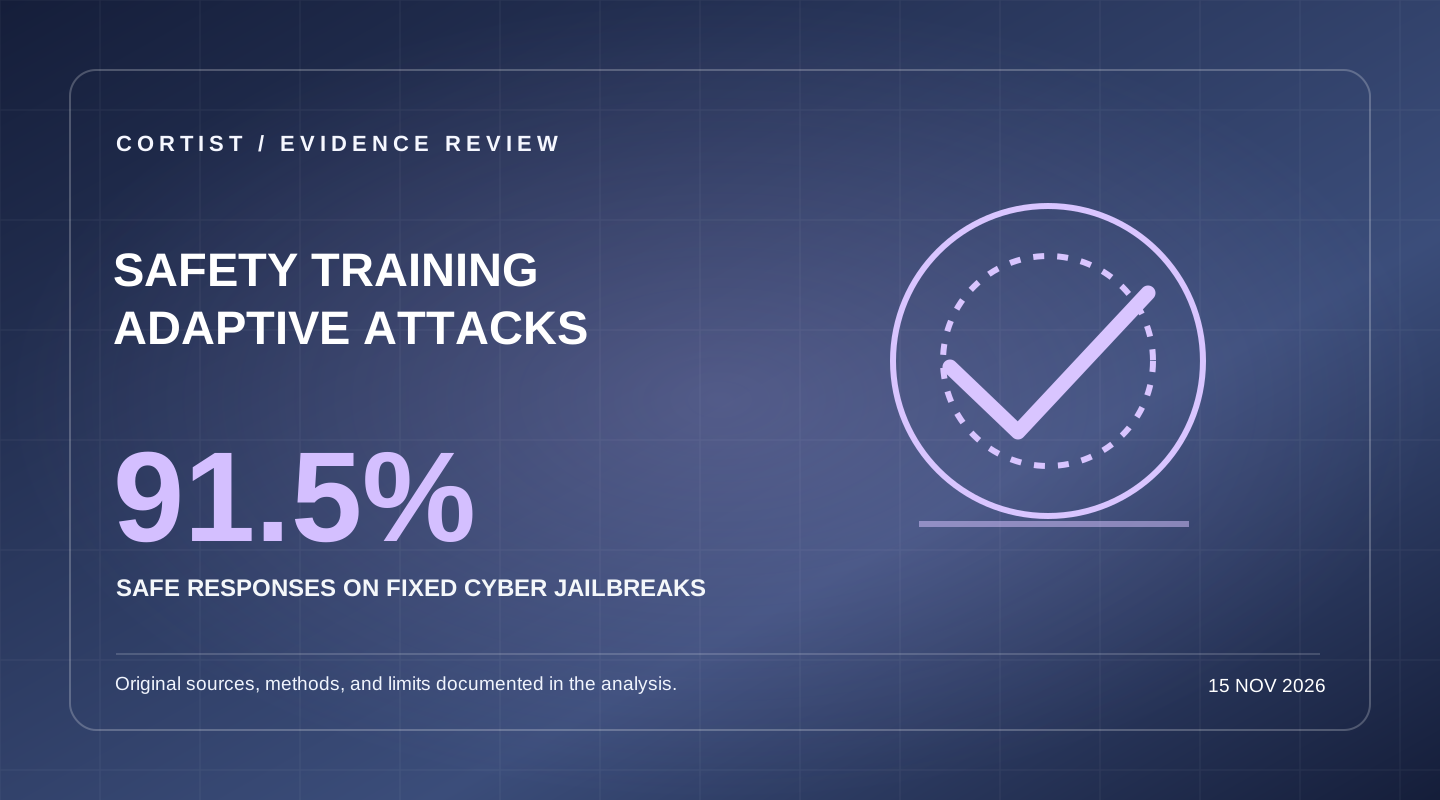
Does GPT-6 Astra's 91.5% jailbreak safety score prove robust real-world safety?
No. OpenAI's November 12 study reports 91.5% safe responses for GPT-6 Astra on a fixed set of cyber jailbreak prompts, compared with 59% for GPT-5.6 Sol. The models and test conditions differ; the numbers do not by themselves isolate the effect of one training method or guarantee safety against adaptive attacks and real-world misuse.
- OpenAI's study focuses on 'fuzzy robustness' in high-stakes dual-use domains including cybersecurity and biology, where harmful assistance is not always neatly separated from useful help.
- The headline fixed-jailbreak cyber result is 91.5% safe handling for GPT-6 Astra versus 59% for GPT-5.6 Sol. OpenAI says these are model-layer evaluations, without broader production access controls and other defense-in-depth safeguards.
- The team uses an automated attacker to refine jailbreak prompts and a worst@n criterion requiring attacks to succeed over repeated tests. A controlled training study reported improved performance against held-out and adaptive multi-turn attackers, though no universal field-level risk reduction was established.
The Signal
An AI assistant can refuse a direct harmful request but comply when the same request is embedded in a longer conversation or disguised as a helpful intermediate step. This is especially difficult in cyber and biology, where ordinary scientific calculations and security procedures can have legitimate or dangerous uses depending on context.
On November 12, OpenAI published research on 'fuzzy robustness': reliable safe behavior under adversarial pressure when the boundary between harmless and harmful tasks cannot be encoded as a simple rule. The researchers used automated attackers to iteratively discover jailbreaks and then trained defensive models on robust adversarial examples.
The standout public number concerns a fixed set of previously discovered cyber jailbreaks. OpenAI reports GPT-6 Astra handling 91.5% of these safely compared with 59% for GPT-5.6 Sol. This comparison is useful evidence of performance under the stated test but is not a randomized trial of one training intervention with identical models.
What the evidence changes
The experimental mechanism tries to avoid relying on easy prompts that a defender already answers safely. An attacker starts from a harmful seed request, receives model feedback and revises the prompt until the response is judged unsafe. The study then filters attacks to favor those that work across repeated trials, rather than one-off random failures. The authors call that repeated-success filter worst@n.
The paper's controlled experiment trains on these strengthened adversarial prompts and evaluates against both a held-out attacker and an adaptive attacker that can improve its prompts using model feedback. According to the authors, this approach made robustness improve on both types of tests. The adaptive result is especially relevant because memorizing a fixed prompt list would not be sufficient to resist a changing strategy.
The research also asks whether safer behavior means a model simply refuses more legitimate work. OpenAI reports that Astra could improve the safety-helpfulness tradeoff on challenging prompts, with fewer inappropriate refusals than earlier models. The figures come from the company's evaluation setups and graders; independent testing remains necessary before treating them as a reliable measure of deployed risk.
The Cortist perspective
Cortist separates four questions often hidden behind a single safety score: whether the model resisted a specific dataset, whether the training approach caused that result, whether it generalizes to new attacks, and whether the complete deployed product reduces harm. OpenAI presents evidence for different parts of this chain, not proof that every part is settled.
The 91.5-versus-59 comparison is particularly easy to misuse. It compares different model generations on fixed jailbreaks, and it does not measure the probability that a determined adversary will fail in a live environment. A better independent audit would specify trial counts, attack budgets, repeated runs, grader agreement and false refusals on clearly legitimate dual-use tasks.
This extends Cortist's recent Anthropic evaluation-methodology coverage. Both studies highlight that benchmark design is part of the claim. The contrast with Cortist's training-data-poisoning article also matters: model-layer defenses and data-mixture vulnerabilities may interact, so no one evaluation should be presented as a complete safety system.
- External tests of the same model versions against unseen, adaptive multi-turn attacks with fixed query and compute budgets.
- Human validation of automated safety graders in ambiguous cyber and biology scenarios, including false-positive refusals.
- Ablation studies that isolate the contribution of robustified adversarial training from other model or product changes.
- Transparent deployment outcomes and additional safety controls, rather than extrapolation from a model-only fixed prompt set.
This is promising experimental evidence that stronger automated attackers can improve training. The defensible claim remains scoped to particular models, graders and attack budgets. For real safety, independent adaptive testing and secure deployment boundaries matter at least as much as the fixed-set percentage.
Frequently asked questions
What does fuzzy robustness mean in this study?
OpenAI uses the term for maintaining safe responses under adversarial pressure in domains where useful and harmful assistance are difficult to separate precisely.
Is 91.5% a guarantee against cyber jailbreaks?
No. It is the reported safe-response fraction on one fixed jailbreak evaluation for GPT-6 Astra without production safeguards, not a success probability against every future attacker.
What is the worst@n attack-selection approach?
The research uses an automated attacker and favors jailbreak prompts that cause unsafe responses repeatedly, making the adversarial training examples less reliant on chance single-run successes.
Original sources and verification limits
Cortist distinguishes original operator incident disclosures, adversarial model evaluations and data releases. We have not independently replicated proprietary tests or verified downstream impacts in production. Source citations are attribution, not validation certificates.
OpenAI Alignment: Improving Fuzzy Robustness in LLM SafetyOriginal research study, November 12, 2026OpenAI Alignment: Eval-production behavior gaps in agent safetyRelated original research on evaluation generalization, November 3; not independent confirmation of fuzzy robustnessReview our methodology, editorial standards and the Evidence Graph.